Most explanations of networking start at the wrong altitude. They begin with protocols, diagrams, and acronyms, skipping over the deeper question: what does it actually mean to move information through physical reality?
1. The Fundamental Shift: From Bits to Waveforms
UART, SPI, I²C interfaces treat communication as digital timing problems. You toggle voltages, sample edges, and hope clocks remain stable. That approach works beautifully up to a few megabits per second.
Ethernet breaks that model.
At modern speeds, Ethernet stops thinking in bits and starts thinking in waveforms. Instead of binary voltage thresholds, it uses multi-level analog signaling, advanced modulation, and real-time signal processing. The wire becomes an analog communication channel, not a digital pipe.
This shift unlocks orders of magnitude more bandwidth.
Rather than sending one bit per symbol, Ethernet uses Pulse Amplitude Modulation (PAM). For example, Gigabit Ethernet uses PAM-5, meaning five voltage levels. That yields more than two bits per symbol. Combine this with four twisted pairs and high symbol rates, and suddenly gigabit speeds appear without violating physics.
At this point, Ethernet PHYs look less like digital logic and more like software-defined radios implemented in silicon. They perform clock recovery, adaptive equalization, echo cancellation, filtering, and error correction (continuously and in real time).
This is why Ethernet bandwidth keeps scaling: it rides on communication theory, RF engineering, and semiconductor progress, not just faster switching.
2. Full Duplex on the Same Wire
Modern Ethernet simultaneously transmits and receives on the same copper pairs.
This is made possible by echo cancellation. Each PHY models its own transmitted waveform and subtracts it from the received signal, isolating the remote transmitter’s data. In real time. At hundreds of megahertz.
Conceptually, this is radar signal processing logic embedded inside commodity networking silicon.
3. What Ethernet Actually Does
Ethernet provides local delivery.
It moves frames between devices on a local network segment using MAC addresses. These addresses are flat, non-hierarchical, and purely local in meaning. Ethernet does not know geography, routing, or topology beyond its immediate neighborhood.
Ethernet answers one question only:
Which device directly connected to me should receive this frame?
That’s it.
4. Why IP Exists
Ethernet alone cannot scale.
MAC addresses contain no location information. There is no structure for routing across large networks. IP introduces hierarchical addressing and global routing semantics.
Ethernet becomes a local courier. IP becomes the global navigation system.
Mechanically, IP packets are simply placed inside Ethernet frames:
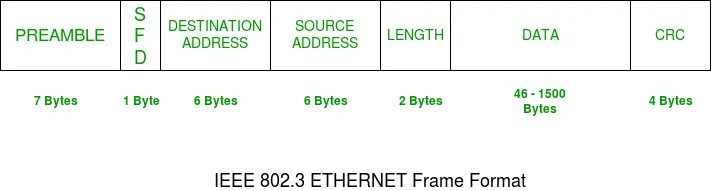
When a packet crosses a router, the Ethernet frame dies and is rebuilt for the next hop, while the IP packet continues its journey.
Ethernet frames are mortal. IP packets are travelers.
5. ARP: The Glue Between Ethernet and IP
When a device wants to send to an IP address, it must discover the destination’s MAC address. This is done via ARP (Address Resolution Protocol), a simple broadcast query on the local network.
ARP dynamically binds logical identity (IP) to physical identity (MAC), allowing the two worlds to interoperate seamlessly.
6. Why Ethernet Bandwidth Is So High
High bandwidth is not about moving more bits. It is about reducing latency, avoiding queue buildup, and preserving determinism.
Modern systems contain:
- Multiple cameras
- Radar
- LiDAR
- High-speed control loops
- Distributed compute
- Logging
- OTA updates
- Redundant safety paths
Raw sensor streams alone can consume gigabits per second. Compression introduces latency and jitter (both unacceptable in safety-critical control systems).
Bandwidth becomes temporal breathing room.
High bandwidth ensures queues remain empty, delays remain bounded, and control systems remain stable.
7. Automotive Ethernet: A Deterministic Backbone
In modern vehicles and robots, Ethernet is no longer best-effort.
OEMs deploy:
- VLANs for network segmentation
- TSN (Time-Sensitive Networking) for deterministic latency
- Multicast for efficient sensor distribution
- QoS for traffic shaping
- Redundant paths for failover
By the time application engineers write software, they inherit a fully engineered, time-aware, deterministic network fabric.
This allows systems to be architected like distributed real-time computers, not collections of loosely connected ECUs.
8. Time: The Missing Dimension
High-speed data is useless without synchronized time.
Ethernet systems distribute time using IEEE 802.1AS (gPTP), a hardware-timestamped precision time protocol. It allows all nodes to share a common clock with sub-microsecond, often sub-100-nanosecond accuracy.
This enables:
- Sensor fusion
- Multi-camera synchronization
- Radar correlation
- Coordinated motor control
- Deterministic scheduling
At the physical layer, clock recovery ensures correct bit timing. At the network layer, gPTP ensures global temporal coherence.
Time becomes a first-class network signal.
9. The Real Architecture
Modern Ethernet systems resemble:
Distributed real-time compute fabrics, synchronized to nanoseconds, carrying massive sensor flows and deterministic control traffic.
They are closer to supercomputers with wheels and wings than traditional embedded systems.
10. The Deep Pattern
Ethernet’s evolution reveals a recurring engineering pattern:
- Push complexity downward
- Expose simple abstractions upward
Inside the PHY: RF engineering, DSP, signal modeling, error correction.
At the software boundary: packets in, packets out.
This separation is why Ethernet has survived decades of hardware evolution and will likely survive decades more.
Final Compression
Ethernet works because it stopped treating communication as digital logic and started treating it as applied physics and probability theory.
IP works because it separates identity from location.
TSN works because it elevates time to a first-class primitive.
Together, they form the invisible infrastructure that allows modern machines (vehicles, robots, factories, data centers) to function as coherent, distributed systems.
Not networks.
Systems.